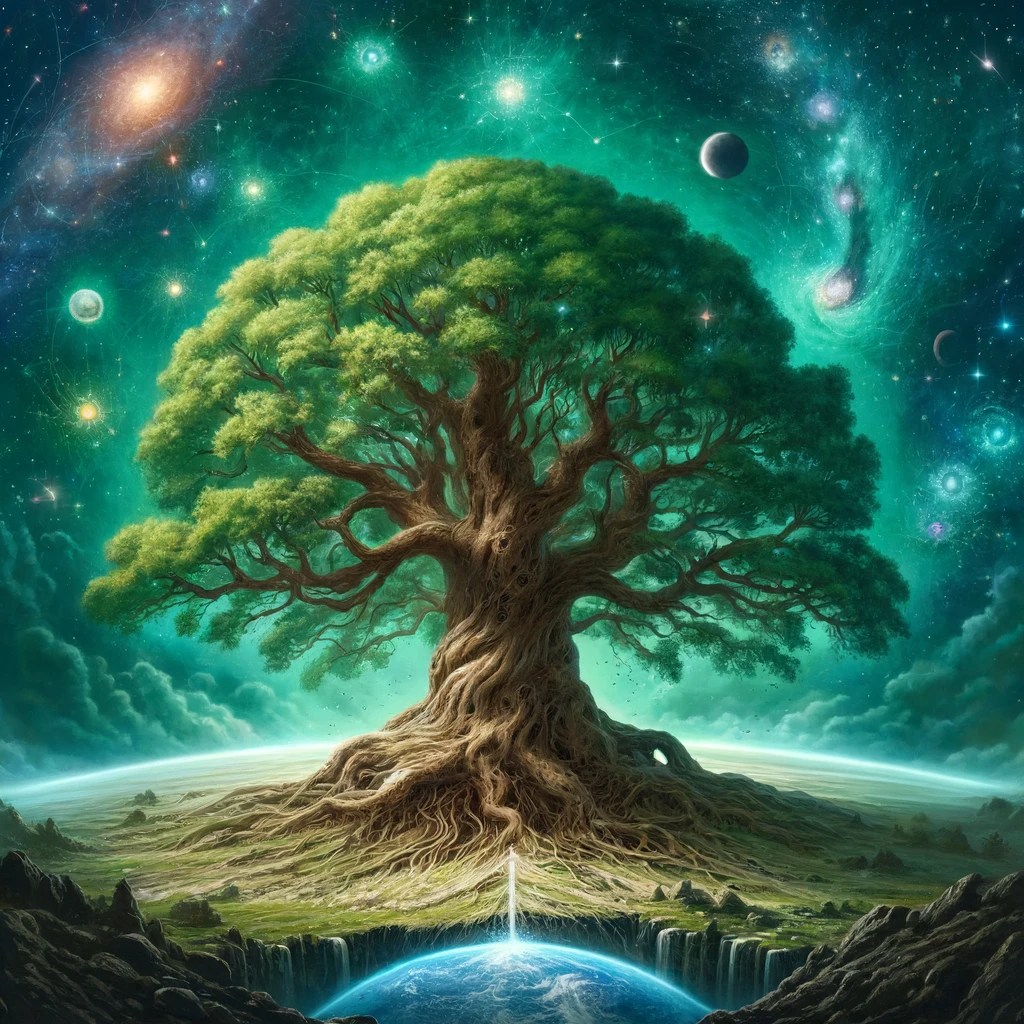
Yggdrasil, often referred to as the World Tree in Norse mythology, is a central and mystical concept deeply ingrained in the cosmology of the ancient Norse people. This colossal tree is depicted as an immense ash tree that connects the nine realms of Norse cosmology. Its name, “Yggdrasil,” is composed of two Old Norse words: “Ygg,” which is a name for the god Odin, and “drasil,” meaning “horse” or “steed.” Thus, Yggdrasil is often translated as “Odin’s horse” or “Odin’s steed,” implying a direct association with the chief god of the Norse pantheon.
According to Norse mythology, Yggdrasil stands at the very heart of the cosmos, serving as a cosmic axis around which the entire universe revolves. Its branches stretch out to support the heavens, while its roots delve deep into the depths of the earth, reaching into realms of primordial chaos. The branches of Yggdrasil are said to extend over the entire world, with its canopy overshadowing the entire cosmos. This portrayal emphasizes the tree’s role as a central pillar that upholds and connects all aspects of existence.
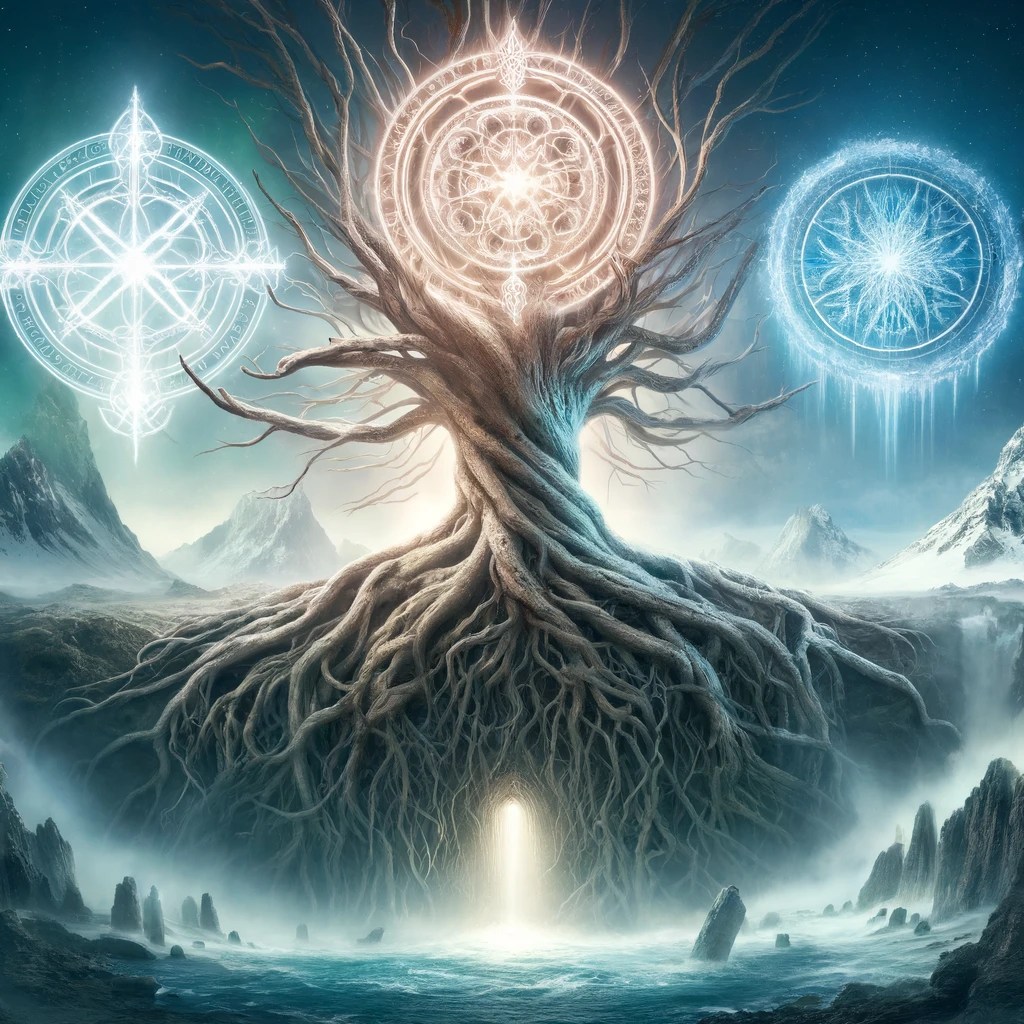
Each part of Yggdrasil holds significance and is associated with different realms and beings within Norse mythology. Its roots delve into three different realms: Asgard, the realm of the Aesir gods; Jotunheim, the realm of the giants; and Niflheim, the primordial realm of ice and mist. These roots draw sustenance from the Well of Urd, also known as the Well of Fate, where the Norns, the Norse fates, reside. The Well of Urd is where the past, present, and future converge, and the Norns weave the threads of destiny.
Yggdrasil’s trunk stands at the center of the cosmos, serving as a pathway between the realms. It is often depicted as a colossal structure, traversable by beings such as the god Odin, who seeks wisdom and knowledge from various sources across the cosmos. Along the trunk of Yggdrasil resides various creatures, including the dragon Nidhogg, who gnaws at its roots, and the eagle that perches atop the tree, with a hawk positioned between its eyes. These creatures symbolize the constant struggle and tension inherent in the universe, as well as the balance between chaos and order.
The branches of Yggdrasil reach out to encompass the realms of existence, including Midgard, the realm of humans, and other realms inhabited by creatures such as elves and dwarves. It is believed that the fate of each realm is intricately connected to the health and well-being of Yggdrasil. Any harm inflicted upon the World Tree would have catastrophic consequences for the entire cosmos, leading to the onset of Ragnarok, the apocalyptic event in Norse mythology.
The imagery of Yggdrasil is rich with symbolism and meaning, reflecting the Norse understanding of the interconnectedness of all things in the universe. It represents the cyclical nature of existence, the interplay between order and chaos, and the ever-present forces of creation and destruction. Moreover, Yggdrasil embodies the idea of cosmic unity, where all beings and realms are ultimately bound together in a vast and intricate web of fate and destiny.
In Norse culture, Yggdrasil served not only as a mythological symbol but also as a source of inspiration and guidance. It offered a framework through which the Norse people could understand the world around them and their place within it. Today, Yggdrasil continues to capture the imagination of people worldwide, serving as a potent symbol of the enduring power and beauty of Norse mythology.
 Yggdrasil Garden
Leave a comment